
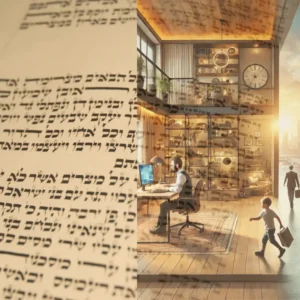

A Blessing and a Curse
Parashat Re’eh begins with Moshe’s call to each individual: “See, I place before you today a blessing and a curse.”
In this verse, the Torah conveys one of its most fundamental truths: every person has free choice. Each one of us is free to make choices in this life, and each one of us is responsible for those choices.
Free choice is not only an important aspect of what it means to be a human being. It is the foundation of Hashem’s relationship with man and of the meaning of human existence.
From the time of Adam and Chava, good and evil became mixed together within human nature. The human inner world became a place of struggle, with a person pulled in different directions. Free choice is the path through which every person navigates this inner confusion and chooses between good and evil.
Hashem does not coerce us. He places the paths before us and allows us to see where they lead. What happens next is in our hands.
The Purpose of the Struggle
Free choice reveals the potential of the human soul. Life without choice would be an automated existence. Because man was created in the image of God, he is capable of conscious and moral choice, even when that choice is difficult.
The Ramchal teaches that the purpose of human life is to present man with opportunities to choose between good and evil. Every situation, from the most intense to the most ordinary, involves the choices we make.
Free choice gives us the dignity of becoming partners in our own spiritual growth. Closeness to Hashem is not simply received; it is earned through effort and through overcoming obstacles.
The struggle with the yetzer hara is therefore not outside Hashem’s plan. Hashem created it and placed it within the human being so that the person could be elevated through the struggle itself.
Even a small choice has meaning: resisting a temptation, turning the heart toward prayer, holding back a harsh word, saying a kind word, or remembering Hashem in a passing moment.
Every moment is new, and every movement toward Hashem is significant.
The Freedom to Choose Again
Rabbi Nachman teaches that free choice is never lost, no matter how far a person may have fallen. Despair tries to convince a person that he no longer has the ability to choose, but the power to take one small step is always present.
Free choice is not necessarily one great moment of transformation. It is the constant renewal of a person’s desire to live in alignment with Hashem.
The Torah does not say that a person must become perfect. It places blessing and curse before him. There is no call here to be perfect. There is a call to choose.
Free will is the power behind teshuva and tikkun. Because a person is free, he is responsible for his actions. But because he is free, he can also return, rebuild, and become renewed.
A person is not only the product of instinct, upbringing, environment, or the past. A person is a soul and can choose.
Hashem places before each of us new opportunities every day. The blessing and the curse are placed before us, and the choice remains ours.