
Three central questions are raised at the beginning of this exploration:
- Why did the Greeks insist that Jews write “we have no portion in the God of Israel” specifically on the horn of an ox?
- Why did they defile the oil in the Beit HaMikdash rather than destroy or steal it?
- Why is it halachically significant to place the Chanuka menora opposite the mezuza?
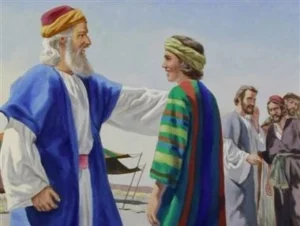
Each question is answered by examining the figure of Yosef HaTzaddik. The Torah and Midrash describe Yosef as a “shor” (ox), representing inner strength and purity under pressure. Isolated in Egypt, Yosef remained faithful in the face of powerful temptation, not because of social norms or fear of consequence, but because of unwavering commitment to Hashem. This capacity to live by faith even when logic fails is what the Greeks sought to undermine.
The Greeks were not opposed to Jewish culture or ritual in principle. Their goal was to sever it from its divine source. Writing on the horn of an ox, a symbol of Yosef, was a way to declare that such resilience and emunah were no longer possible. The defilement of the oil served a similar purpose: not to eliminate the ritual, but to strip it of its purity. Impurity, in this case, represents a denial of spiritual reality that cannot be seen or measured.
In Jewish thought, oil represents wisdom and the soul. Like fire, the soul cannot be touched, but it moves upward, gives to others without diminishing itself, and never rests. The Greeks targeted the oil because they rejected anything that transcended logic or physical perception.
The halachic requirement to place the menora opposite the mezuza holds profound symbolic significance. The mezuza guards the home from within; the menora shines light outward into the world. Together, they represent the two domains where one must remain faithful: the inner private realm and the external public sphere. Yosef remained true in both, and the lights of Chanuka remind each generation that such integrity is still within reach.
The essence of Chanuka is not cultural continuity, but spiritual resilience. Even when explanations are lacking, even when clarity is absent, a Jew can still choose light.
“NOTE: The above is a summary based on the original teaching.”