

In our parasha, we have the two dreams of Pharaoh. He wakes up in the morning, and he is beside himself. He calls all the sages and the sorcerers of Egypt to come to rescue, so to speak, to interpret the dream. That’s not something we find kings necessarily do. Even with the dream of the butler and the baker, they were not going around telling their dream to Yosef. Yosef saw that they looked different, that they did not look good, and he had to press and probe until they felt comfortable to even share their dream.
But here, Pharaoh gets up in the morning and he is completely beside himself. He has to call all the sages of Egypt to come in. Rav says that this is because it wasn’t just a regular dream; there was an element in the dream that gave a message to him that he was very concerned about. Usually, a king has dreams, and it’s all fine, you don’t get up in the morning calling everyone. But here, there was an element that was exactly the opposite of what a king would think or dream about. Usually, you dream about things that are a product of your thought process—of you being strong, of the strong destroying the weak.
Here, both elements of the dream were the weak overpowering the strong. The stalks of wheat, which were destroyed, devoured and destroyed the strong ones. The weaker cows swallowed the stronger ones. That’s what Pharaoh wanted to know, maybe it’s an overthrow of his government that was indicated in this dream.
And of course, we know that in some peculiar sense, it was exactly what was happening: the entire government of Egypt being handed over to the hand of Yosef. The culture of Mitzrayim is being changed to the degree that Pharaoh, who had declared himself as a god—says, “Can you find a man like this, like Yosef, who has a Godly spirit?” Yosef stands there speaking and giving in to that, the government of Mitzrayim being handed over to the power of someone who speaks the words of Hashem. One person governing the empire of Mitzrayim.
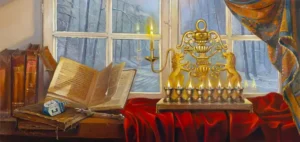
It’s the same story of Chanuka: the culture of the many into the hands of the few, the strong ones being delivered into the hands of the weaker ones. That is the power of Torah, the power of an ever-burning flame, of spiritual power in the world. When you have the pure oil that’s not contaminated, that mindset of attachment, of complete devotion and dedication to the mindset of Torah, to the devoting ourselves to the learning and the doing of the Torah—that little flame can push so much darkness. It can deliver the giborim (the strong ones) into the hand of the weak, the many into the hand of the few.
That’s the story of Chanuka. It was then, in the time of Yosef, and it is now—today. Not just in the time of Pharaoh, but today in our time. It should be that the light should push away all the darkness of the world, with us meriting to light the Eternal Light.