
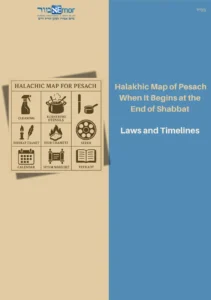
PESACH 5786 – A Halachic Map of Pesach

Halakhic Map of Pesach - Laws & Timelines
An essential overview for when Erev Pesach falls on Shabbat.

CHAMETZ – THE CENTRAL PROHIBITION

What is Chametz?

Chametz is any food product made from wheat, barley, oats, rye, or spelt that has leavened (fermented) for 18 minutes or more. It includes bread, cakes, cookies, pasta, and beer.

Three Torah Prohibitions:

  • Bal Yera’eh: One may not see chametz in their possession during Pesach.
  • Bal Yimatzeh: One may not own chametz during Pesach.
  • Akhilat Chametz: One may not eat chametz during Pesach.

Disposal of Chametz:

  • Bedikat Chametz (Search): Done on the night of the 14th of Nissan, using a candle (or flashlight). A berakha is recited before the search.
  • Bi’ur Chametz (Burning): Performed the following morning before the 6th halachic hour. 
  • Bitul Chametz (Nullification):
    • Recited twice; the first declaration is said after the search.
    • The second is recited after the burning – after disposing of any remaining chametz.

🔗Link to Bedikat & Bi’ur Chametz guide

Mekhirat Chametz (The Sale of Chametz):

Chametz that cannot be consumed or destroyed before Pesach is sold to a non-Jew via a rabbi, through a formal legal sale. 

🔗Link to Mekhirat Chametz online sales

PREPARATIONS BEFORE PESACH

Cleaning the Home:

All rooms, especially those where food is eaten or stored, must be cleaned thoroughly of chametz.

🔗Link to Pesach cleaning guide

Kashering the Kitchen:

Utensils and surfaces that will be used for Pesach must be kashered properly. The method depends on how each item is normally used (direct heat, liquid, etc.).

EREV PESACH

🗓️ WEDNESDAY, APRIL 1, 2026

TA’ANIT BEKHOROT – FAST OF THE FIRSTBORN

It commemorates Hashem’s sparing the firstborn sons of the Israelites during the Tenth Plague in Egypt, when all Egyptian firstborns were struck down.

WHO FASTS, WHEN, AND WHAT TO DO

  • A firstborn male who is the first to open his mother’s womb (peter rechem) is obligated to fast. Likewise, a firstborn male from the father’s side is also obligated to fast.
  • If the firstborn is a child, his father fasts on his behalf.
  • The fast is normally observed on the 14th of Nissan, but when Erev Pesach falls on Shabbat, it is moved earlier, as mentioned above.  
  • Though it is technically a fast day, the widespread custom is for firstborns to attend a siyum—the festive completion of a Talmudic tractate—which exempts them from fasting for the remainder of the day.

🗓️ TUESDAY NIGHT

  • Bedikat Chametz
    To be done on Tuesday night, starting at nightfall, once the stars appear. By that time, all cleaning must be completed in any area that may have contained chametz during the year.
  • Care must be taken to set aside any chametz needed for the next day, so it is not lost.

🔗Link to Bedikat & Bi’ur Chametz guide

🗓️ WEDNESDAY, APRIL 1, 2026

  • Bi’ur Chametz – Burning of Chametz
    Chametz should be burned by the end of the fifth halachic hour on Wednesday, approximately 11:40 AM. After eliminating the chametz, the Kol Chamira nullification is recited at this time.
  • Sale of Chametz
    The sale of chametz is typically completed by 11:40 AM on Wednesday. One should consult the designated rabbinic authority for the precise time at which the sale will take place.

CHOL HA’MO’ED (INTERMEDIATE DAYS)

Work Restrictions:

Certain types of work are prohibited unless necessary for Yom Tov needs or to prevent financial loss. Ask a halakhic authority as needed.

Simcha and Activities:

These days are for spiritual growth, family time, and simcha (rejoicing). Matza is still eaten (though not obligatory if one prefers not to eat it), and chametz remains forbidden.

LAST DAYS OF PESACH

The 7th Day:

Commemorates Keriat Yam Suf (Splitting of the Sea). Full Yom Tov with festive meals, prohibited labor, a special Torah reading, and Hallel.

The 8th Day (in the Diaspora):

  • Yizkor is recited.
  • Some hold Moshiach’s Se’uda in the afternoon, with stories and singing about redemption.
Havdala

Havdala is the ceremony that marks the end of Shabbat and the transition back to the regular week. It includes blessings over wine, spices, and fire.

Havdala consists of the following stages: 

    1. Verses  
      • Although not required, verses that express our hope for a positive week are customarily recited at the beginning of Havdala.
      • Ashkenazim recite a series of verses beginning with “Hinei Kel Yeshu’ati” (Yeshayahu 12:2) available here, while Sephardim recite a series of verses beginning with “Rishon Letzion” (Yeshayahu 41:27) available here .
  • Wine
    • Blessing: Borei pri hagafen is recited on the cup of wine.
    • Practical Guidelines:
      • Ideally, use kosher wine or grape juice.
      • If unavailable, significant beverages like beer or coffee may be used. 
      • According to some opinions, one may also use other significant beverages if one prefers them over wine. 
  1. Spices (besamim)
    • Blessing: A blessing is recited on fragrant spices. 
      • Ashkenazim: The general blessing of Borei minei besamim (Who creates types of spices) is recited.
      • Sephardim: Specific blessings are recited, such as Borei atzei besamim (Who creates fragrant branches) or Borei isvei besamim (Who creates fragrant herbs).
    • Practical Guidelines:
      • One should not use spices designed only to remove a foul odor (such as bathroom freshener). 
      • If the one reciting havdala cannot smell, another individual recites the blessing during havdala (Ashkenazim) or after havdala (Sephardim).
  2. Candle
    • Blessing: Borei me’orei ha’esh is recited on the flame.
    • Practical Guidelines:
      • Preferably, use a special havdala candle with multiple wicks.
      • After the blessing, view one’s fingernails by the light to appreciate the flame. Some halakhic authorities hold that one does this before reciting the blessing.
  3. Blessing of Separation and Drinking the Wine
    • Blessing: The blessing of “Hamavdil” is recited, which marks the distinction between “holy” (i.e., Shabbat) and “mundane” (i.e., the weekdays), followed by drinking the cup of wine. 
    • Practical Guidelines:
      • Everyone should listen to the blessing without interruption, as missing part of this blessing invalidates the mitzva.
      • The leader drinks the wine; others may assist if necessary.

The leader must drink at least a cheekful (approximately 44 cc). Ideally, a full revi’it (86 cc) is consumed, requiring an after-blessing.

  1. Symbolic Meaning
    • Purpose: Havdala, which means separation, transitions from Shabbat’s sanctity to weekday activity. The blessing’s text, “He separates between holy and mundane, between light and dark…between the seventh day and the six days of work,” reinforces that holiness is preserved through separation. 
    • Symbolism:
      • Smelling spices enables the soul to cope with losing the additional soul (neshama yeteira), which joins a person on Shabbat. 
      • Seeing the flame commemorates the creation of fire on Saturday night by Adam in the Garden of Eden. 
      • Smelling spices and seeing the flame also awaken the senses, helping to carry Shabbat’s spiritual elevation into the week.
  2. Mystical Insights 
    • Neshama Yeteira: In addition to the connection between the departure of the additional soul and smelling the spices, the entire havdala ceremony also helps ease the loss of the additional soul.
    • Symbolism of Ritual Objects:
      • Candle: Reflects divine light.
      • Wine: Represents divine abundance.

Separation and Integration: Light and darkness represent distinct realms, as do sacred and mundane and Shabbat and the rest of the week. However, light illuminates the darkness, the holy illuminates the mundane, and Shabbat illuminates the rest of the week. Havdala demonstrates that these different realms must remain distinct but that Shabbat can impact the rest of the week, bridging sanctity with the material world.